Cross-Platform Enterprise Mobile Apps with .NET MAUI
Architecting high-performance, native mobile solutions for iOS and Android using a single C# codebase. Discover why .NET MAUI is our framework of choice at MograSoft—powering flagship products like our custom KSC app.
 Click to Expand
The Cross-Platform Native Advantage
In enterprise mobile engineering, choosing between native speed and cross-platform efficiency is no longer a trade-off. Microsoft’s **.NET MAUI (Multi-platform App UI)** enables software architects to target Android, iOS, Windows, and macOS from a single C# and XAML codebase while generating 100% native platform controls under the hood.
1. Why .NET MAUI Leads Modern Mobile Engineering
Unlike hybrid frameworks that wrap web views in a container, .NET MAUI compiles directly to platform-native code, providing true native performance, access to underlying OS APIs, and seamless hardware integration.
Core Architectural Strengths:
- Single Project Structure (`Platforms/` foldering): Manage multi-platform assets, fonts, icons, splash screens, and platform-specific configurations (`AndroidManifest.xml`, `Info.plist`) within a unified SDK project file.
- Handler Architecture: Replaces legacy Xamarin renderers with lightweight, high-performance Handlers that directly map abstract cross-platform controls to native Android (`Android.Views.View`) and iOS (`UIView`) components.
- Hot Reload & Hot Restart: Speeds up UI iteration across multiple connected physical devices or emulators without performing full application rebuilds.
- Built-in Hardware Access: `Microsoft.Maui.Devices` and `Essentials` provide standardized C# APIs for geolocation, camera, biometrics (Touch ID / Face ID), accelerometer, and secure storage (Keychain/Keystore).
2. Native Execution on Android & iOS
.NET MAUI delivers tailored compilation strategies designed specifically for each mobile operating system's execution model and security requirements.
| Platform Target | Compilation Strategy | Native OS Integration |
|---|---|---|
| iOS / iPadOS | Full Ahead-Of-Time (AOT) compilation into native ARM assembly binaries adhering strictly to Apple's sandbox security. | Direct access to CoreML, ARKit, iOS Push Notifications (APNs), and UIKit controls. |
| Android | Just-In-Time (JIT) or Profiled AOT compilation targeting Android Dalvik/ART runtimes for optimal startup speed. | Direct binding to Material Design, Google Play Services, FCM messaging, and background workers. |
3. Real-World Spotlight: The MograSoft KSC App
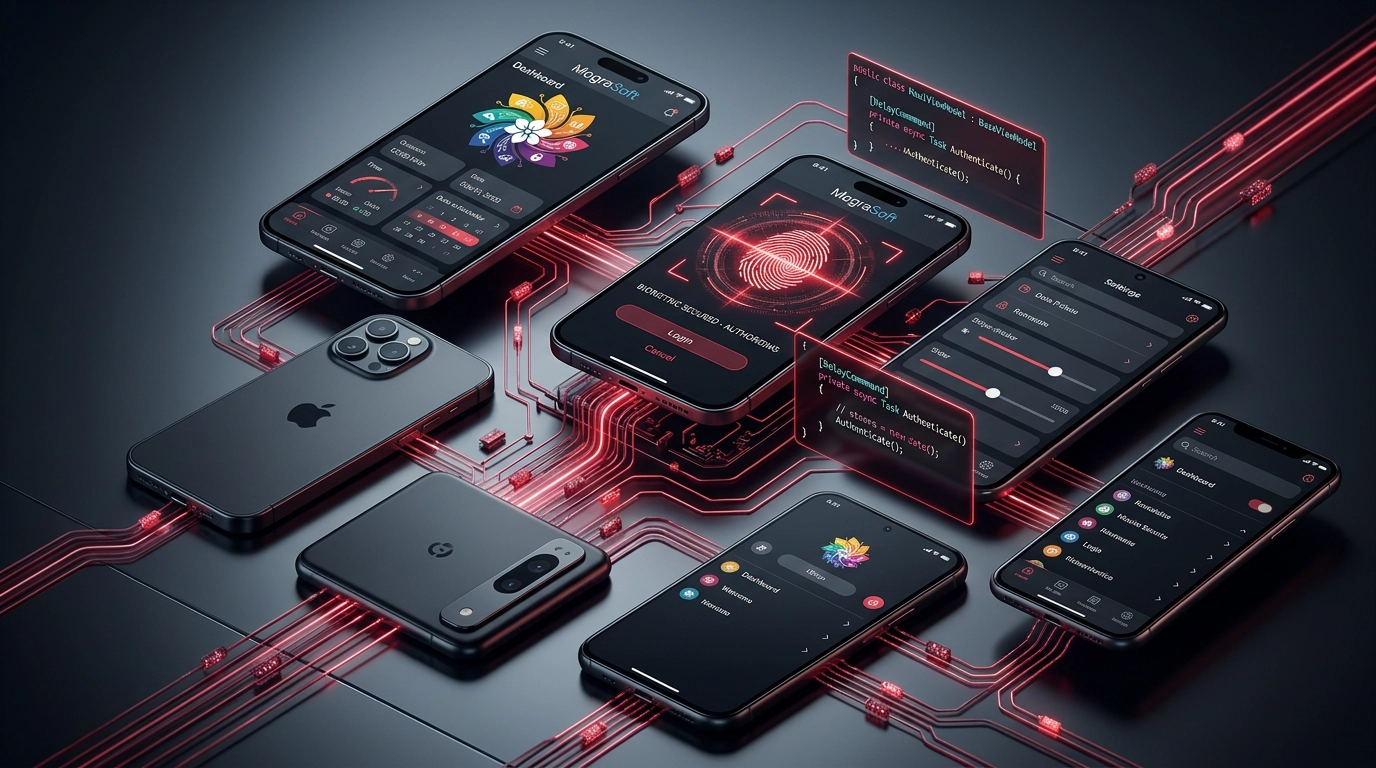
At **MograSoft**, we put our engineering principles into practice. We leveraged .NET MAUI to design and build our custom **KSC Mobile Application**, delivering a high-reliability, feature-packed client experience across Android and iOS devices.
Biometric Security
Integrated device biometrics via standard MAUI authentication abstractions for instant, secure user logins.
Offline Data Sync
Leveraged SQLite and automatic background retry policies to maintain app responsiveness in low-connectivity environments.
MVVM Pattern
Powered by the CommunityToolkit.Mvvm for clean source-generated property bindings and command handling.
public static class MauiProgram
{
    public static MauiApp CreateMauiApp()
    {
        var builder = MauiApp.CreateBuilder();
        builder
            .UseMauiApp<App>()
            .ConfigureFonts(fonts => {
                fonts.AddFont("OpenSans-Regular.ttf", "OpenSansRegular");
                fonts.AddFont("OpenSans-Semibold.ttf", "OpenSansSemibold");
            });

        // Register Core KSC App Services & ViewModels
        builder.Services.AddSingleton<IKscApiService, KscApiService>();
        builder.Services.AddTransient<KscDashboardViewModel>();
        builder.Services.AddTransient<KscDashboardPage>();

        return builder.Build();
    }
}
4. Strategic Advantages for Enterprise Teams
Why Businesses Choose .NET MAUI:
- Reduced Time-to-Market: Writing UI and business logic once cuts development cycles by 40-50% compared to maintaining dual native projects.
- Leverage Existing .NET Expertise: Enterprise backend C# developers can seamlessly contribute to mobile development without learning Swift, Kotlin, or Dart.
- Unified Testing Suite: Shared unit tests (xUnit) and automated UI tests validate cross-platform logic across all OS targets.